Securing funding is one of the most exciting yet rigorous challenges you will face as a founder. Often, your very first impression on an investor isn’t a firm handshake or a charismatic speech—it is a file sitting quietly in their inbox. Crafting a compelling startup pitch deck is the crucial first step to opening doors, communicating your vision, and ultimately securing the capital you need to scale.
However, building a great deck is more than just throwing some bullet points onto a slide. It requires deep empathy for your reader, a rock-solid narrative, and the right technology to showcase your product in its best light. If you want to stand out in a crowded inbox, you need a strategy.
Know Your Audience and Your Format
Before you even think about design or software, you must define the foundational elements of your pitch. A successful deck is never “one-size-fits-all.” Your messaging and your format must adapt to the people you are talking to and the environment in which they are consuming your information.
Tailoring to the Audience
Your pitch deck will differ depending on exactly who is reviewing it. Are you sending it to a venture capital firm focused on hyper-growth? They will want to see massive market potential and a scalable business model. Are you showing it to potential early-adopter customers? They will care much more about the specific problem you are solving for them and the immediate product features. Always keep your target audience in mind and adjust the weight of your slides accordingly.
The Read Deck vs. The Presentation Deck
A critical mistake many founders make is using the exact same file for every situation. You actually need to differentiate between two distinct types of decks:
- The Presentation Deck: This is what you project onto a screen when you are pitching live on stage or in a boardroom. It features massive visuals, very minimal text, and relies entirely on your voice track to fill in the context.
- The Read Deck: This is the classical pitch deck you send to investors via email before or after a meeting. Because you are not there to explain the nuances, this document must be completely self-explanatory. It requires more text, detailed data, and a clear, logical flow.
For the purpose of this guide, we are focusing heavily on the Read Deck. Why? Because in the real world of startup fundraising, the informative use case is the most common. People send files to investors, or event hosts gather slides to open on a single master machine. The Read Deck is the workhorse of your fundraising campaign.
The Anatomy of a Classic Pitch Deck
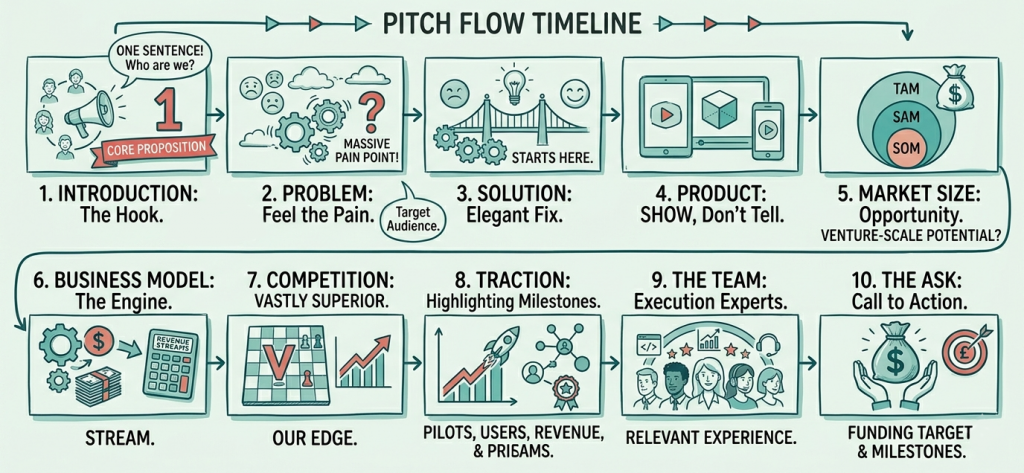
While you should always let your unique brand shine through, venture capitalists and angel investors expect a certain rhythm to your presentation. Sticking to a proven structure helps them digest your information quickly. Here are the essential slides you need to include:
- The Introduction: Keep it incredibly brief. Who are you, and what is your core value proposition in one single, memorable sentence?
- The Problem: What is the massive pain point your target audience is experiencing? Make the investor feel the pain.
- The Solution: How does your startup elegantly solve this problem?
- The Product: Show, don’t just tell. This is where you demonstrate how your product actually works and what the user experience looks like.
- The Market Size: How big is the opportunity? Use realistic metrics (TAM, SAM, SOM) to prove there is venture-scale potential here.
- The Business Model: How do you actually make money? Explain your pricing strategy and revenue streams.
- The Competition: Who else is doing this, and why is your approach vastly superior?
- Traction: What have you achieved so far? Highlight revenue, active users, strategic partnerships, or successful pilot programs.
- The Team: Why are you the exact right people to execute this vision? Highlight relevant industry experience and past successes.
- The Ask: How much money are you raising, and exactly what milestones will that capital help you achieve?
The PDF Trap: Why Standard Decks Lose Investor Attention
Once your masterpiece is complete, you face a major technical hurdle. Investors universally ask for your deck in a PDF format. It is safe, it cannot be accidentally edited, and it opens on any device without missing fonts or formatting errors.
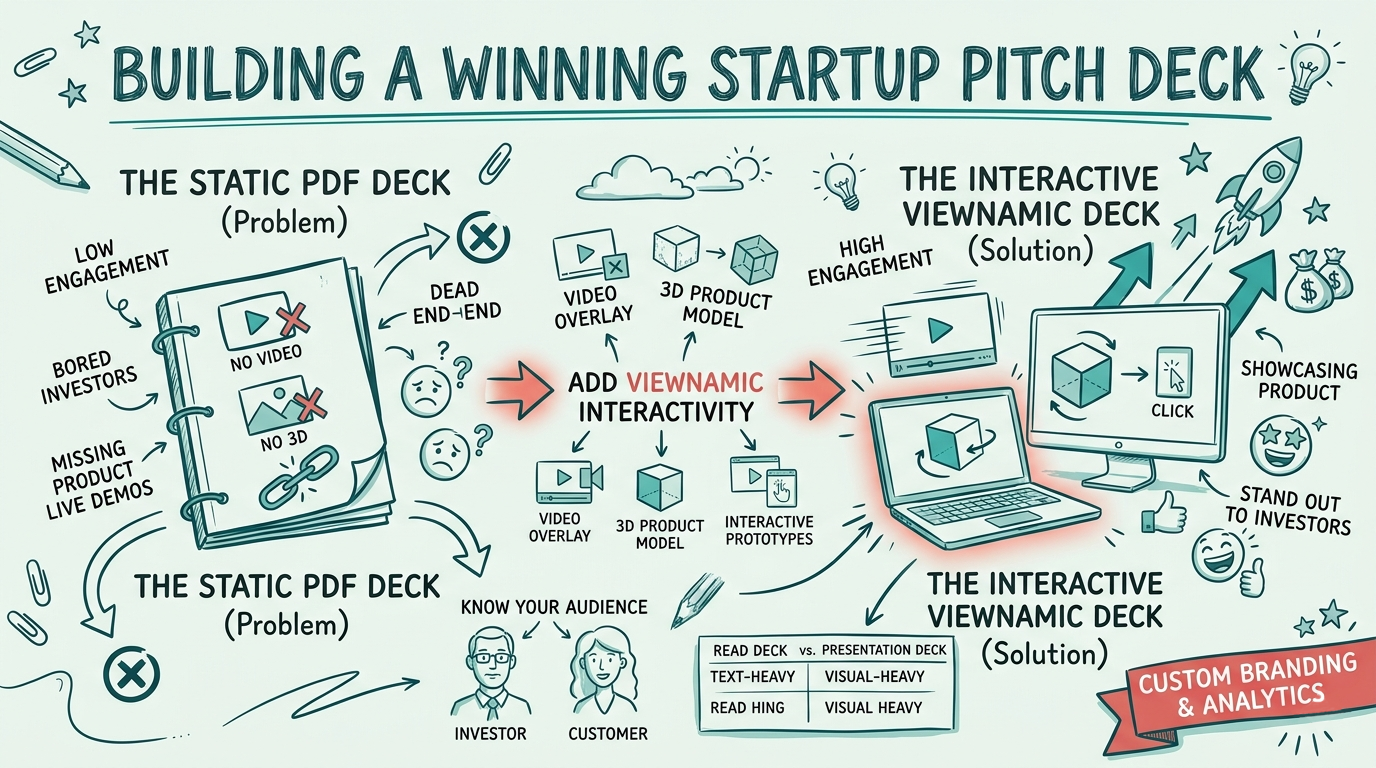
But exporting a presentation from PowerPoint, Keynote, or Figma into a PDF creates a massive problem: your deck becomes completely static. All the interactive elements that make your startup special are instantly stripped away. That high-quality explainer video you spent hundreds of hours on? It is reduced to a flat screenshot. Your interactive 3D product model? It becomes a lifeless 2D image. Even worse, if you want to show a product demo or a click-dummy, you have to force the investor to click external links, taking them out of the document and ruining the reading experience. In a competitive landscape where you need to hook an investor’s attention immediately, a static document simply doesn’t do your product justice.
The Viewnamic Solution: Stand Out with an Interactive Pitch Deck
You no longer have to choose between the professional reliability of a PDF and the engaging nature of modern web content. With Viewnamic, you can securely send a standard PDF to investors while injecting it with rich, dynamic elements.
Viewnamic allows you to take your exported PDF and seamlessly add dynamic content like a 3D model of your hardware product, a prototype click dummy, or an embedded founder video. All of that content is directly included into your pitch deck. When the investor opens the link, they experience a natural scrolling and reading flow, but when they reach the product slide, they can engage with a vivid demo without ever leaving the viewer.
Keep Your Brand Front and Center
Furthermore, presenting your deck through a generic file viewer doesn’t exactly scream “unicorn potential.” Viewnamic allows you to fully customize the web viewer to match your startup’s corporate design. You can adjust the colors, branding, and interface to ensure that from the moment the investor clicks your link, they are fully immersed in your brand experience. You also gain valuable insights through analytics, letting you know exactly which slides investors are spending the most time on.
Start Pitching Smarter Today
Your startup pitch deck is the key to unlocking your next stage of growth. By understanding your audience, optimizing for the “Read Deck” format, and following a clear, narrative structure, you immediately put yourself ahead of the pack.
Don’t let the limitations of a standard PDF flatline your product’s potential. By transforming your static slides into an engaging, interactive experience, you can ensure your product demo shines and your startup is remembered. Check it out for yourself here.
Ready to see exactly how powerful an interactive pitch deck can be? Experience it for yourself and explore the Viewnamic Pitchdeck.